

A story of shape, colour, and centuries of royal obsession - from palaces to modern India
Discover pearl shapes, colours, and why kings, queens & Indian brides have loved pearls for 4,000 years. How NVP Jewellery reimagines pearls with modern heritage design.
1. Born of the Sea, Worn by Royalty
No gemstone carries myth and majesty quite like the pearl. It isn’t mined or cut. It’s grown – a living jewel formed when a mollusk wraps layers of nacre around an irritant. The result is organic perfection. To ancient cultures, that was magic. To kings and queens, it was power.
The Romans called them ‘margarita’, meaning “child of light.” The Persians believed pearls were formed when rainbows met the sea at moonlight. In India, the Sanskrit word ‘mukta’ means “pure” and “liberated” — because pearls were thought to free the soul from impurity.
For 4,000+ years, pearls weren’t just jewellery. They were currency, diplomacy, and divine right
2. The Language of Shape: Every Pearl Tells a Story
Round
The most coveted. Perfect spheres were so rare that entire wars were financed to find them. Symbolized eternity, perfection, and the moon. Queens like Cleopatra and Elizabeth I wore ropes of round pearls to signal untouched authority.
Drop & Pear
Teardrop shapes were prized for earrings and pendants. The ‘La Peregrina’, a 50.5 carat pear-shaped pearl, passed from Spanish royalty to Elizabeth Taylor. It hung from portraits of Mary I and Philip II of Spain — a symbol of dynastic marriage.
Baroque
Irregular, asymmetrical, wild. Renaissance Europe loved baroque pearls for their uniqueness. Jewellers in 16th-century Augsburg carved them into mermaids, dragons, and mythical beasts. To wear baroque was to say “nature and I are co-creators.”
Button & Coin
Flat on one side. Mughal emperors stitched thousands into jamas and turbans. The weight alone was a flex — only royalty could carry kilos of pearls and still walk upright.
Keshi & Seed Pearls
Tiny, accidental pearls formed without a nucleus. In Victorian England, seed pearls were embroidered into mourning jewellery. In India, they’re woven into ‘satlada’ necklaces — seven strings of tradition worn by brides.
Today, shape still signals intent. Round = classic power. Baroque = artistic rebellion. Drop = romantic legacy.
3. The Spectrum of Colour: More Than Just White
White & Cream
The classic. Akoya pearls from Japan set the standard. For centuries, “white” meant purity, virtue, and wealth. Queen Victoria wore white pearls exclusively after Prince Albert’s death. The message: unbroken dignity.
Golden
South Sea pearls from the Philippines, Indonesia, and Australia. The deeper the gold, the rarer. Mughal emperors hoarded them. Emperor Jahangir recorded his pearl treasury by weight — he owned ‘maunds’ of golden pearls. In Hindu tradition, gold pearls invoke Lakshmi: prosperity that multiplies.
Black & Tahitian
Actually peacock green, aubergine, silver. From French Polynesia. French Empress Eugénie shocked 19th-century courts by wearing them. Black pearls meant mystery, night, and feminine power outside the “pure bride” narrative.
Pink, Lavender, Blue
Freshwater pearls from China. Conch pearls from the Caribbean — flamingo pink and impossible to imitate. In India, pale pink pearls are called ‘gulabi mukta’ and prescribed in Ayurveda for calming the heart.
Grey & Champagne
Understated luxury. Modern royalty like Queen Maxima of the Netherlands favors grey South Sea strands — regal without shouting.
Nacre thickness decides lustre. That’s the real value. A dull pearl, no matter the colour, was never fit for a crown.
4. Popularity Among Kings and Queens: The Ultimate Status Symbol
Ancient World
Cleopatra once dissolved a pearl in wine and drank it to win a bet with Marc Antony that she could host the most expensive dinner in history. That single pearl was worth an entire country’s tribute
Roman Empire
Julius Caesar passed a law: only aristocrats could wear pearls. Commoners caught wearing them faced penalties. Pearls were that politically charged.
Mughal India
The ‘Pearl Mosque’ in Agra. The ‘Peacock Throne’ inlaid with pearls. Emperor Shah Jahan’s ‘khilats’ — robes of honour — were stiff with pearl embroidery. Abu’l Fazl, Akbar’s chronicler, listed pearls as the first of seven royal treasures. Why? They travelled well, held value, and could be strung, unstrung, gifted, or melted into power.
Elizabethan England
Elizabeth I’s “Armada Portrait” shows her drowning in pearls — literally hundreds. Each one was a statement: England’s virgin queen was married to her country, and her dowry was the sea itself.
Russian Tsars
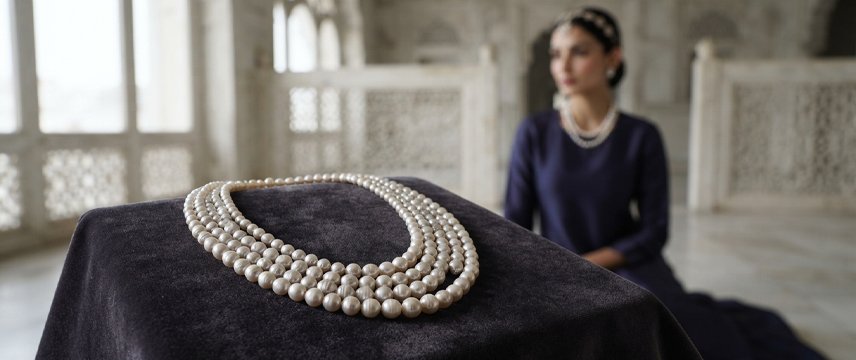
The Romanovs owned the ‘Imperial Pearl Parure’. Catherine the Great wore 3-row chokers so heavy, she needed ladies-in-waiting to support her neck during court.
20th Century Icons
Jackie Kennedy’s triple-strand faux pearls. Princess Diana’s pearl-and-sapphire choker. Grace Kelly’s wedding pearls. They all understood: diamonds impress, pearls ‘disarm’. They soften power without diluting it.
5. India and the Pearl: A 3,000-Year Love Affair
Scripture & Science
The ‘Garuda Purana’ lists pearls as one of the nine sacred gems of the ‘Navaratna’. Ayurveda prescribes ‘Mukta Pishti’ — pearl calcium — for acidity, anxiety, and to cool ‘pitta dosha’. Pearls aren’t ornaments here. They’re medicine.
*Hyderabad: The City of Pearls*
Since the Qutb Shahi and Asaf Jahi dynasties, Hyderabad has been the pearl capital. Why? The Gulf of Mannar and Persian Gulf were ancient sources, and Hyderabad was the trading hub. Nizams didn’t wear one string. They wore ‘satlada haar’— seven strings — and ‘chandanhaar’ that reached the waist. The last Nizam, Mir Osman Ali Khan, used pearls as paperweights.
Today, Charminar’s lanes still sell ‘Basra pearls’, ‘Keshi’, and ‘seed pearl jadas’ by the tola. Brides from Gujarat to Bengal come here for their trousseau.
Bridal Culture
No Indian wedding is complete without pearls.
– South India: ‘Muthu maalai’ with temple jewellery. Pearls offset gold’s heat.
– North India: ‘Nath’ with pearl drops, ‘passa’ with pearl fringes. They frame the face during ‘pheras’.
– Mughal influence: ‘Jhoomar’ and ‘tikka’ with pearl hangings — still worn by Muslim and Rajput brides.
Symbolism: Pearls represent the moon, fertility, and ‘saubhagya’ — marital bliss. A bride in pearls carries the ocean’s calm into a new home.
Modern India
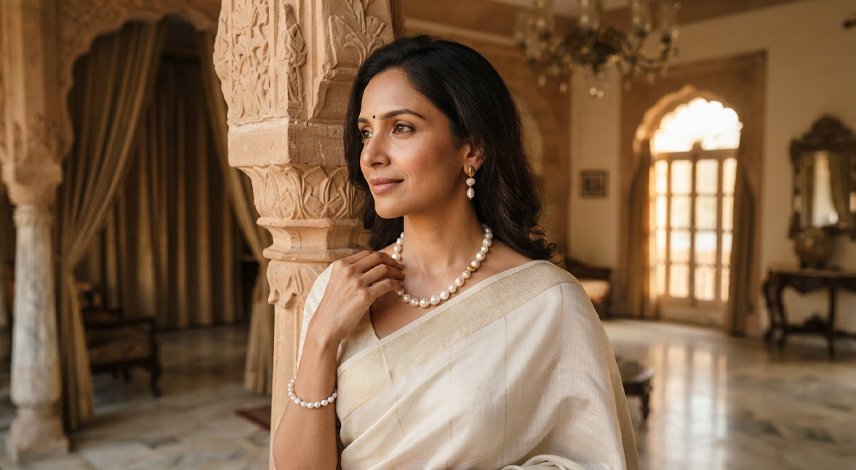
Today’s Indian woman wears pearls differently. Baroque pearl ear cuffs with saris. Single golden South Sea pearls on silk cords with power suits. NVP’s own ‘Emerald Drop Earrings’ — emeralds and diamonds — still nod to tradition, because pearl-drops were Mughal earring staples.
Pearls have moved from ‘only’ bridal to ‘boardroom to baraat’. That’s India’s relationship with them: evolving, but never broken.
6. Why Pearls Endure: The Psychology of Soft Power
Diamonds are forever. But pearls are ‘human’.
They’re warm to touch. They age with you. Their lustre deepens with wear because your skin’s oils polish them. No other gem needs you to stay beautiful.
Kings wore them to show they controlled nature. Queens wore them to show nature obeyed ‘them’. In India, we wear them to remember that purity and power aren’t opposites.
From Cleopatra’s wine to a Hyderabadi bride’s ‘satlada’, the message is the same:
You don’t own pearls. They choose you.
7. The NVP Pearl: Where Modern Heritage Takes Shape
At NVP Jewellery, pearls aren’t locked in tradition — they’re rewritten for the woman who owns her legacy. We source the finest South Sea, Akoya, and keshi pearls for their unmatched lustre and nacre, then set them in designs that speak today’s language. Think baroque pearls framed by uncut diamonds in 22k gold, or a single golden pearl suspended on a sleek, modern chain — heritage ‘karigari’ meeting clean, architectural lines. From our Mumbai atelier, every piece is handcrafted to move seamlessly from boardroom to baraat. Because for NVP, a pearl isn’t just worn. It’s ‘lived in’. A diamond chooses its master, and our pearls choose women who carry history forward without being bound by it.


